Cheap Behind The Veil (International, Political, & Economic History) Discount Review Shop
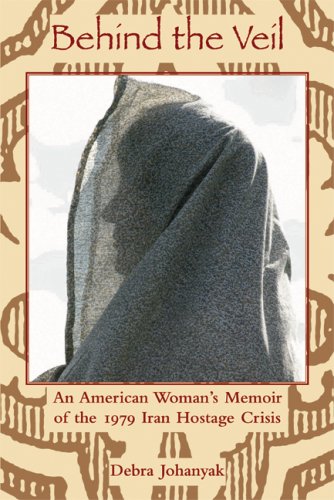
"The chief symbol of my private and political dilemma was the veil, or chador. Resisting urgings and threats to cover myself in public during that chaotic epoch of 1979-80 grew out of a resolve to maintain my personal identity," writes Dr. Debra Johanyak in the introduction to a thrilling memoir of her experiences in Iran, particularly during those 444 days when the world waited to learn of the fate of the American embassy hostages.
In 1974 at a Midwestern University, Debra, a single-mother and the Assistant International Student Advisor, meets Nas, an Iranian student. After a whirlwind campus courtship, Nas proposes to Debra and presents her an unusually romantic gift. Debra is swept away and says, "Yes." She confides that her family were "not shocked" at her betrothal, for mixed marriages were not uncommon. A generation earlier her Baptist mother had married her father of Russian Orthodox background. From scrutiny of the little things that Nas does, such as his devotion to and legal adoption of Debra's son, it is clear that he truly loves her and marries her not just for the green-card. While the INS makes certain that it isn't a marriage-of-convenience, there is no doubt that Debra would not have agreed, if she had any doubts of Nas's affection.
Opportunities in Iran beckon and, in 1977, Debra and Nas along with their two little boys move to Shiraz. Debra is thrilled to be there, and her first impression on arrival is to marvel at the "bluest sky I had ever seen - and the warmest sun." She is received with open arms by Nas's family and there is nary a harsh word from them to her. Although, within the year, Debra returns to the States, following an emergency surgery, Nas pursues her there and brings her back to Shiraz. However, in 1979 Iran is much changed following the departure of the Shah and the return of Ayatollah Khomeini. Although, there is political unrest in the capital, Tehran, Nas and Debra feel they are safe in the out of the way city, Shiraz. Nevertheless, time would prove them to be wrong.
Debra resumes her English teaching position at the university and also enrols in graduate studies. While life at home continues normally - they have a flat of their own - it is at the university and in the streets that Debra faces the most harassments. Having a naturally dark complexion, likely inherited from her grandfather's intersecting Native American bloodline, she could have passed for a Persian, yet it was her attire that mostly drew attention to her.
Following the demonstrations and protests in Tehran, demanding the return of the Shah from the US, the turmoil spreads towards Shiraz. It was not long after the militant's takeover of the embassy, in November 1979, that Debra feels the first inkling of the chaos. One evening three young women follow her from the bus stop and shout at her to go home and put on a chador. The other shocking occurrence is when she reads on an orchard wall, written in blood-red letters a threatening assertion: "Women who don't wear veils are whores. Men who don't make them are pigs." Other incidences of verbal and physical harassment follow - one even of a sexual nature that she escapes miraculously due to the timely appearance of Nas.
Life could not have been the same for Debra after these occurrences. Her Iranian family remain dispassionate and even the strong-headed Nas, on her question, whether or not to wear a veil, replies, "I don't know." She is even escorted to a church - at a secretive location. However, there are some hints for her to conform, at least in public, such as her sister-in-law taking her to a tailor under the pretence of, "You need new clothes for the university." For Christmas a family friend goes to great lengths to bring her a pine tree. But most of all she is thrilled to receive a present of a chiffon fabric `lovely printed chador'. While Debra puts it away in a bottom drawer, it comes in handy one day.
While Debra succumbs to at least wearing a beret, she steadfastly refuses to wear the chador. It would seem she wishes to live in an in-between world that of the country club crowd and the Islamic fundamentalists. Her reasons being: " ... I had studied Islam in college, and Pari and I often discussed our divergent beliefs. I also had seen the militant side of Islam in the embassy takeover, and in Zahra's adopted identity. But I felt it was not right for me. I believed in Christianity, though I was not sure what to do about it, especially in an Islamic country. I began thinking more about my spiritual state. How ironic that my soul should awaken in an Islamic culture!" In the end Debra believes that she made the right decision.
The book is very well written, as Dr. Johanyak is not only a highly educated person, but also teaches, among other subjects, Creative Writing - and it shows in the book's structure, plot, characterization, dialogue, and narrative. Aficionados of history will truly enjoy this book, for it has much historic details told in the appealing usual `trappings' of page turning intrigue and chapter ending hooks. While this memoir is somewhat different than Ms. Mahmoody's, "Not Without My Daughter," it is thrilling just the same. There are many anecdotal descriptions of life in Iran, the culture, customs, and the cuisine, not only in the cities but also in the rural areas were Debra and Nas often visit. In typical espionage-novel style there are heart-beating incidences, such as the time when one night returning from the village their car is stopped at a roadblock, but they manage to get away without the discovery of Nas's loaded revolver! There are many humorous moments as well, for instance when one night the huge rodents residing in between and gnawing the walls of their house, decide to: ... if Carter wasn't ready to act, the rats were. That night they made their move... writes Debra.
The one revelation that I personally found most intriguing was when Debra relates a comment made by one of her Shiraz University professors: Some of us worried the situation would turn worse, while others thought the prisoners would be released in the near future. "Wait until Ronald Reagan gets elected," one of the male professors said. "The hostages will be released like that!" He snapped his fingers for emphasis. I found it interesting that people in that far off university were attuned to US politics.
Although, the recent Jan 20th anniversary date of the release of the hostages seemed to have passed by quietly (except for an article in our Canadian national newspaper), it was likely remembered by many. Dr. Debra Johanyak's book is an important contribution towards understanding the East-West relationships and the turmoil that is still engulfing the Middle East. The memoir's basic message, in Debra's words, emerges as: "While mutual distrust continues over oil supplies and nuclear capabilities, it is time to put hostilities aside and begin building a new relationship based on mutual respect."
Reviewed by, Waheed Rabbani, a historical fiction writer living in Ontario Canada. His The Azadi Trilogy Book I: Doctor Margaret's Sea Chest was published in Dec 2008 and is available on all Amazon and other bookstores.
 Available at Amazon
Cheap "Behind The Veil (International, Political, & Economic History)" Discount Review Shop
"Behind The Veil (International, Political, & Economic History)" Overview
Married to an Iranian, and mother of two young children, Debra Johanyak was a teaching assistant at Iran's Shiraz University when the American Embassy in Tehran was taken over by militants on November 4, 1979. Behind the Veil tells the story of a woman with dual citizenship who loves both the United States and Iran but must choose between them when the embassy takeover triggers an international and personal crisis.
Johanyak recounts the events of her life in Iran, drawing on her own journal and family letters, as well as public news sources. Against a background of increasing political and religious tensions, she gives the reader vivid pictures of the world she experienced there, in good times and bad--tribal customs in a village wedding, sandstorms, the warmth of the large Iranian family she married into, the threatening pressure of Islamic fundamentalists. Coming face to face with dramatic changes in Iran's government and society, Johanyak must also confront her own identity.
For anyone who has ever wanted to look behind the veil of media imagery and see life in Iran before and after the 1979 revolution, Debra Johanyak's book offers a clear, intimate, and unflinching view of a culture in conflict, as she comes to terms with her religious faith, political views, and feminist values. Behind the Veil chronicles a dangerous time in Iran and America's shared history, and brings us along on the spiritual and intellectual pilgrimage of one Midwestern woman Wnding her way in a volatile world.
Available at AmazonCheap "Behind The Veil (International, Political, & Economic History)" Discount Review Shop
"Behind The Veil (International, Political, & Economic History)" Related Products
- The Roots of Evil: The Origins of Genocide and Other Group Violence
- Heritage of World Civilizations, The, Volume 2 (8th Edition)
- King Leopold's Ghost: A Story of Greed, Terror, and Heroism in Colonial Africa
- Western Civilizations 2 Laminated Reference Guide (Quickstudy: Academic)
- First Course in Statistics, A (10th Edition)

0 ความคิดเห็น:
แสดงความคิดเห็น